




The co-founders of Yeti Scat Trails are bringing traditional and nontraditional forms of Nepalese hash to Washington’s cannabis market

Yeti Scat Trails general manager Karl Stevenson says the key to making hash is the curing phase which can take anywhere from a couple of days to weeks.
Somehow, hash never saw a burst of popularity in the modern recreational market.
It was a regular subject in the bud-porn-soaked back issues of High Times, a mysterious brown loaf, sometimes stamped with a medallion or branded with a logo and typically without much more explanation than a photo credit. These images were once a regular inclusion alongside pictures of hidden fields, home grows and juicy colas, photo sections that comprised fantasies for many readers. And while the legalization of cannabis has become reality in many states, hash remains an elusive, exotic and often forgotten product.
When Karl Stevenson and Norm Johnson launched Yeti Scat Trails in Washington in 2022, they hoped it would help popularize hash in the United States.
“We’re trying to lead people toward the more sophisticated form (of cannabis),” Stevenson says.
Between Stevenson, the company’s general manager, and Johnson, the CEO, it’s hard to imagine a company with more expertise in the world of traditional hash. Yeti Scat Trails has slowly built a following of hash converts, but the primary obstacle has been educating the public about hash and why the founders believe it’s a superior product to flower.
“One of the big issues we’ve faced from the very beginning here is just that people don’t understand what hash is,” Johnson says.
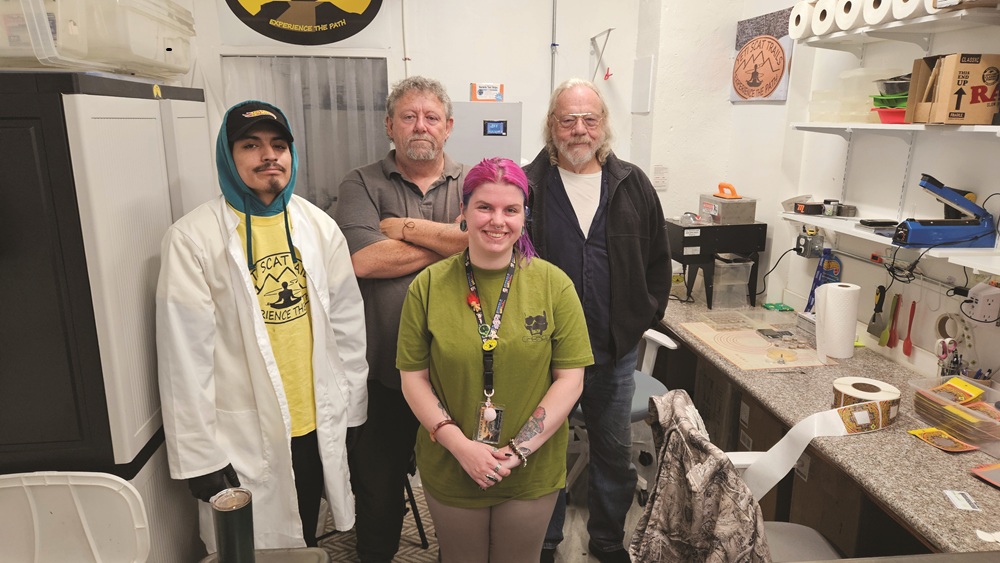
The Yeti Scat Trails team (from left to right): hash craftsman Sammy Sanchez, general manager Karl Stevenson, packaging QA Holly Haynes and CEO Norman Johnson, Ph.D.
The Argument for Hash
Yeti Scat Trails makes hash using traditional Nepalese methods, meaning the company starts with an ice bath to separate the cannabis essence from the plant material, followed by a process of filtering and a very long and meticulous curing phase where the product can slowly form a skin to lock in the terpenes and flavors indefinitely.
“Good hash doesn’t have a shelf life,” Stevenson says.
It can take anywhere from a couple of days to weeks of curing for the outer shell to form on the hash, depending on the source material and THC level, but the result is a nuanced, sophisticated flavor and experience for consumers.
The THC of the finished product can vary, but it’s typically around 50%, Stevenson says. The flavor profiles can vary greatly from one batch to the next, and the taste and smell become much more prominent once the outer layer has been broken.
Many consumers inaccurately conflate hash with high THC, when it’s actually much more than that. In some ways, it’s a different category of products than the waxes, shatters and oils that represent a larger chunk of the market.
“It’s all the other organic chemistry that’s going on that we’re trying to convey, along with the THC to make it an experience,” Johnson says.
A similar comparison could be made with a fine wine or a fine tequila.
“Tequila is not pure alcohol,” Johnson explains. “It has contaminants, intentionally, because that’s what makes tequila, tequila. A good analogy is that there are 4,000 different tequila makers and all of them have a different taste.”
The color of the hash can also vary by the age of the plant at harvest, with older plants producing a much more amber color, while younger plants turn pale in comparison.
“It’s all the other contaminants that make it have its character and really gives it its flavor, its nuances and its enjoyment,” Stevenson says. “So that’s where we concentrate our efforts.”

Eastern Influence
The earliest form of hash, known as “charas,” was made from simply collecting plant resin by hand and dates back to roughly 10,000 years ago in Central Asia. More modern hash production practices are believed to have been popularized in the Middle East, with its earliest evidence dating back to a pamphlet published in Cairo in 1123. Throughout history, there have been three major hubs for hash production: Nepal, Lebanon and Morocco, though Johnson says Morocco is “just a copy of the Lebanon tradition, which is older.”
“The only difference between the Lebanese hash and the Nepalese hash is how they cure it,” Johnson says, explaining that production in Lebanon’s Beqaa Valley is under extremely dry desert conditions and uses warm water, whereas in Nepal, production is at a high altitude where it’s very dry and cold. “So, they get different results.”
Stevenson learned firsthand about hashmaking while he was enlisted in the military and stationed in Istanbul. After leaving the service, he spent decades making hash at home.
“Hundreds and hundreds and hundreds of pounds of hash,” Stevenson says.
Johnson was first introduced to hash through friends in New York City, but became much more involved in its production when he worked as a telecommunications consultant in the Middle East during the ‘70s and ‘80s.
“I was working in Saudi Arabia where it’s a death penalty if you even get caught with drugs,” Johnson says. “I just couldn’t get off on the local alcohol, which was also illegal, so I went ahead and took a trip to Nepal and spent a couple of weeks there with the locals, learning how they make hash, and ended up smuggling some back to Saudi Arabia in hollowed out shoes through Pakistan.”
Niche Market
One of the most vexing parts of educating consumers about hash is how much more popular hash rosin and other extracts are.
According to data from Headset, hash and bubble hash products combined have made up 0.16% of retail sales in U.S. cannabis markets in 2025. In the Washington market, the share is slightly higher at 0.22%.
Over the past five years, hash’s market share has remained remarkably consistent, representing about 1.75% of the overall concentrates category.
“There’s a market for it here, although it is niche,” Stevenson says. “I mean, everybody else in the world smokes hash — they don’t smoke flower.”
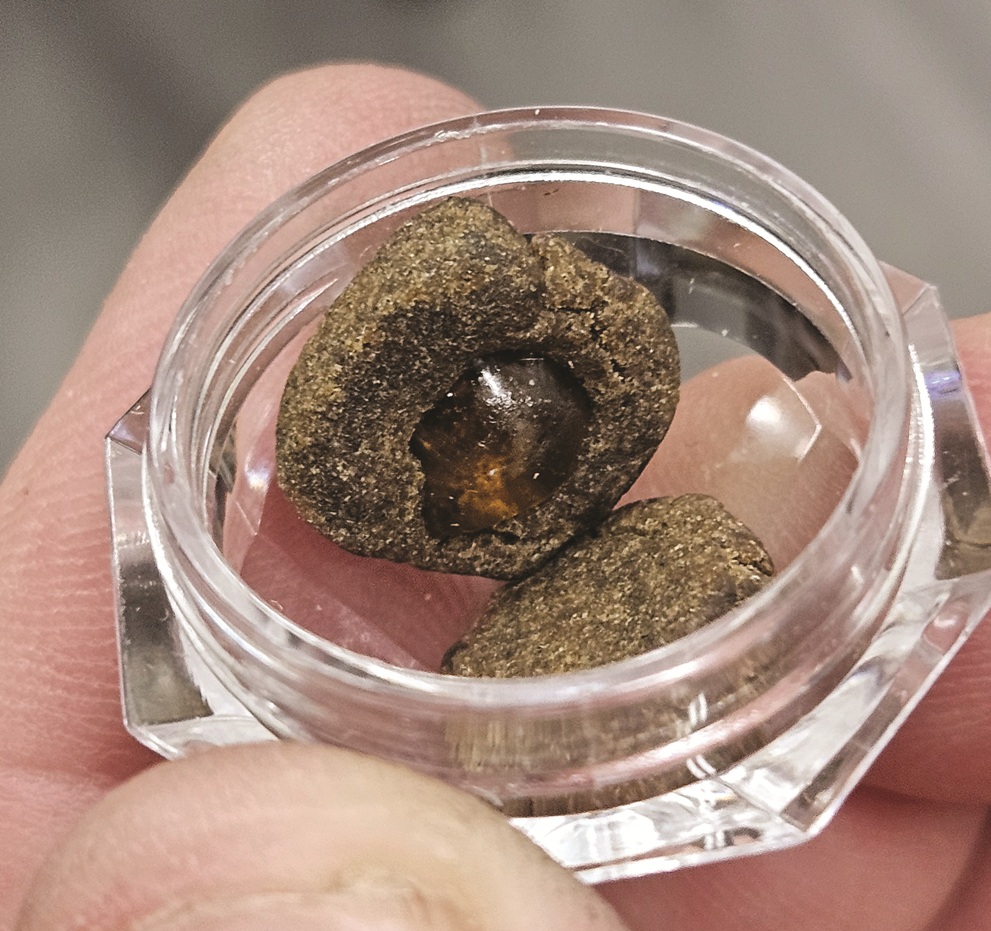
Washington-based Yeti Scat Trails is introducing new variants of hash to the market such as its diamond-wrapped Avalanche Tokes.
Innovating on the Formula
Bringing traditional Nepalese hash to Washington consumers is the undeniable heart of Yeti Scat Trails. The company’s Cornucopia Temple Hash is a traditional style product, while the Powdered Temple Hash is a deconstructed variant that is easier to add to edibles and beverages.
But the company isn’t above blending ancient processes with modern cannabis innovations. Yeti Scat Trails has teamed up with Green Reaper to produce two new products: Avalanche Tokes, which are THC diamonds wrapped in hash; and Glacier Tokes, which have crushed THC diamonds pressed into traditional Nepalese hash.
“I’m always trying to come up with something different, ideas that people will like and would be interested in having,” Stevenson says.
Glacier Cookies, a sandwich cookie with a layer of wax rosin pressed between two small pucks of hash, is another new product on the horizon.
While Yeti Scat Trails aims to stay within the realm of traditional hash, the company is also looking to deliver its own take on growing product trends, such as infused pre-rolls and cones, which Stevenson believes will be a gateway for consumers to try traditional hash products. A 2-gram infused pre-roll will be debuting soon, Stevenson says.
“A lot of the people want the most bang for their buck, so to speak, and I’m doing my best to give that to them,” Stevenson says.